Solutions — Backend IoT
Every RFID device in your fleet, reachable from a single cloud API.

All ACD agents expose local APIs for direct integration. The Backend IoT is the optional cloud layer on top — it connects to every agent via MQTT, manages the full device fleet, and exposes a single REST API to your systems. Your RFID devices become IoT objects, manageable from anywhere.
Download BrochureOne cloud layer to manage your entire RFID fleet
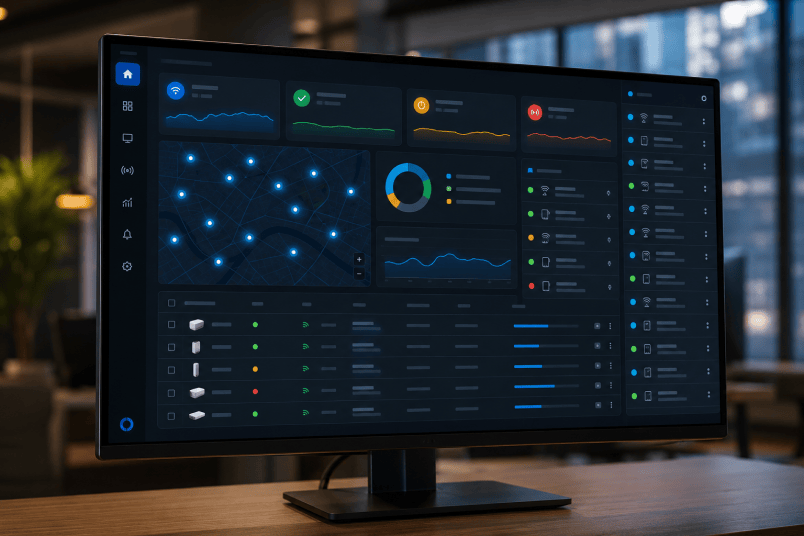
Commands flow cloud-to-device. Events and readings flow device-to-cloud. Status and telemetry keep you informed in real time. Three data flows, one unified API for your integrations.
HOW IT WORKS
Four layers that turn distributed RFID devices into a managed, cloud-connected fleet.
-
01 — Device connectivity
MQTT over TLS, from any network
Every ACD agent connects to the Backend IoT via MQTT over TLS. The platform runs on Azure Event Grid MQTT — fully managed, zero maintenance, scaling automatically from 100 to 10,000 devices. Devices auto-register on first connection.
-
02 — Fleet management
Approve, activate, monitor, disable
New devices enter a PENDING state and are approved by an operator. From that point they are ACTIVE — receiving commands, sending events. The lifecycle (PENDING → ACTIVE → DISABLED) is fully managed from the dashboard or via API.
-
03 — Command & response
Send a command, track the result
Commands are sent from the REST API to the device via MQTT and correlated to their response by UUID. Commands can be queued for offline devices or rejected immediately — configurable per command type. Status visible in real time via WebSocket.
-
04 — Events & telemetry
All data, structured, timestamped
RFID readings, operational events, and device heartbeats are stored in a time-series database (TimescaleDB on Azure PostgreSQL) with 90-day retention for raw reads and 180 days for events. Accessible via REST API and real-time WebSocket streams.
Cloud-native, Azure-based
Deployed on Azure Container Apps with automatic scaling — from zero to thousands of devices, with no infrastructure to manage.

Integrations
REST API, WebSocket, MQTT
Your systems connect via REST API for commands and data queries, and via WebSocket (STOMP) for real-time event streams. Devices connect via MQTT TLS — same protocol, whether in production on Azure or in development on a local broker.