Case Study — Manufacturing & Logistics
RFID traceability across a manufacturing warehouse
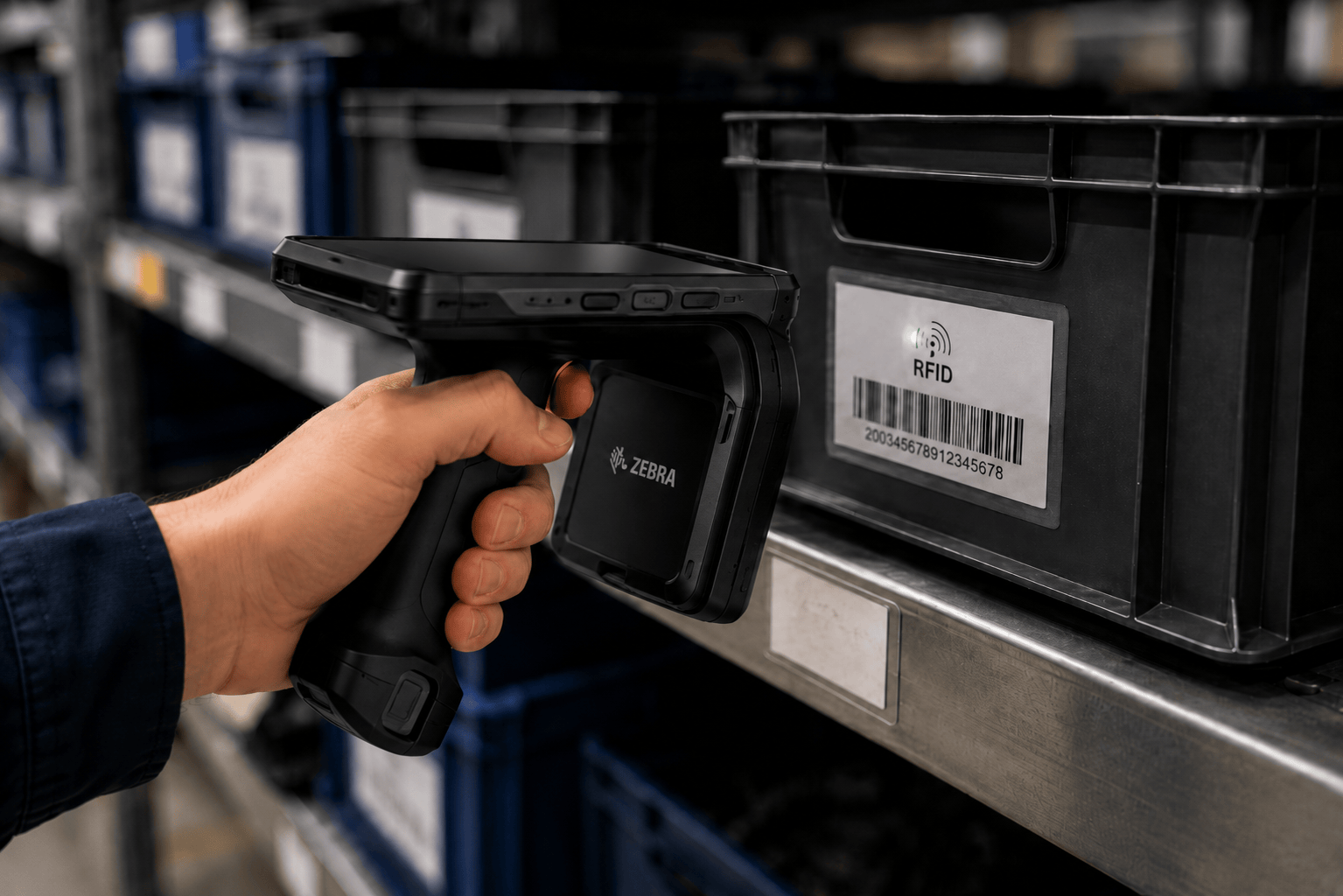
How Monchiero extended their existing WMS with RFID — using Device Manager Mobile on Zebra handhelds to cover inbound, stock movements, outbound, and inventory without replacing any existing system
Stock going missing. No visibility on where.
Monchiero manufactures complex machinery. Their warehouse handles a high mix of parts — plastic cassettes, large individual pieces, components going to and from external subcontractors. The problem wasn't volume. It was visibility: items went missing between inbound and production, and tracking down where they were meant asking people, not querying a system. The project goal was clear: introduce RFID traceability across inbound, stock movements, outbound to subcontractors, and inventory — without replacing the existing WMS or disrupting how Sistemi Tre's application worked.
RFID on top of an existing WMS
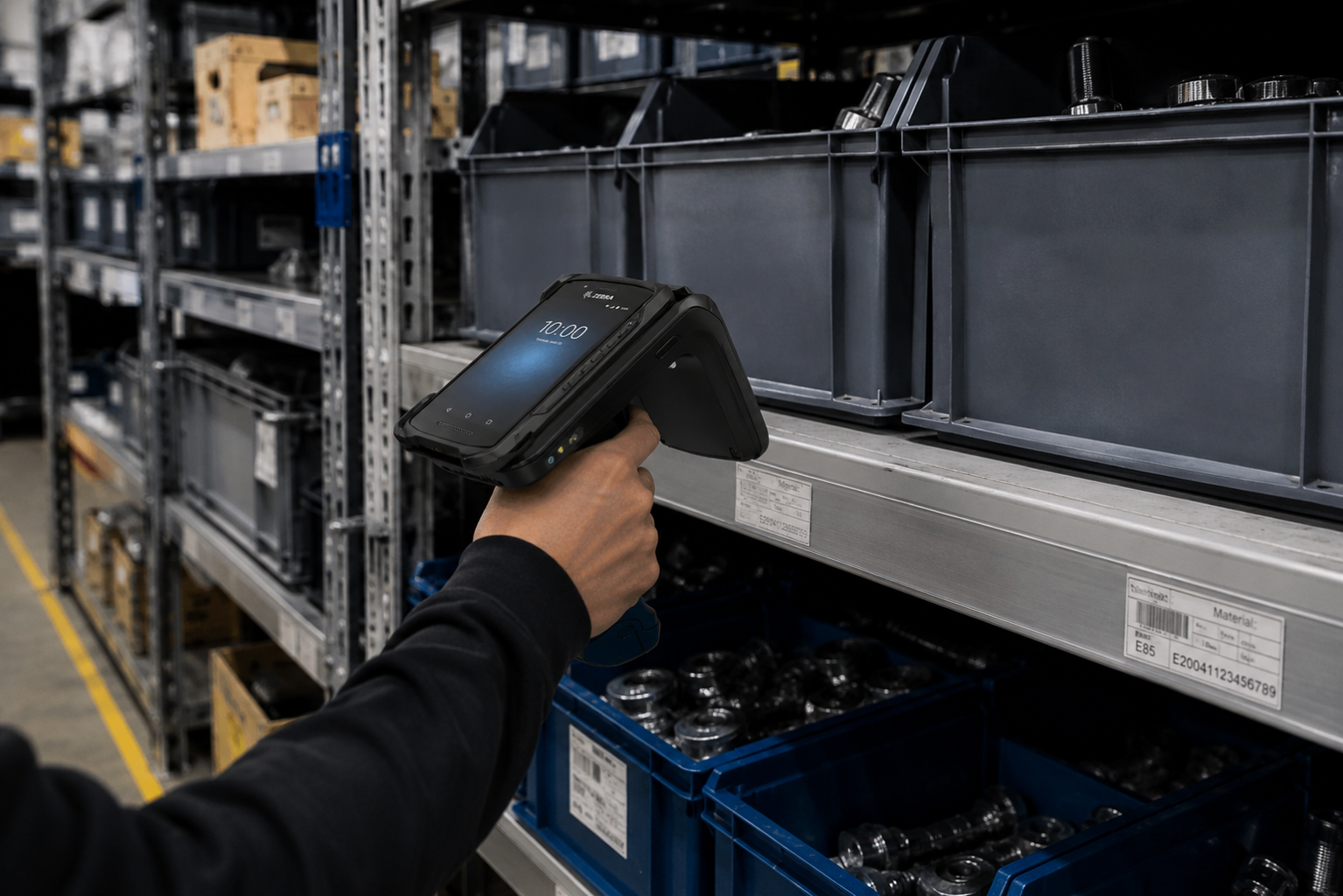
Sistemi Tre extended their WMS with new RFID-aware functions: inbound receiving, stock placement, outbound preparation, and inventory scanning. The existing application logic stayed intact. The new screens talked to the RFID layer through Device Manager Mobile — an Android agent installed on Zebra RFD40 handhelds that exposed the same REST/WebSocket interface as any other ACD agent. Sistemi Tre's developers integrated it without having to learn anything about Zebra's native SDK.
Tags on cassettes and hanging labels on parts
RFID tags were applied on two types of carrier: plastic cassettes for small components, and hanging plastic labels for larger individual pieces. Tags were printed and encoded on Zebra ZT411R printers directly from the WMS. The encoding followed GS1 SGTIN standard, with serials generated by the WMS itself — no external registry required. Checkpoint Systems supplied the RFID tags: purpose-built for metal applications and designed to be suspended where needed. SPQF designed the process flows, managed the integration between ACD and Sistemi Tre, and ran joint testing through to UAT.
"We needed RFID to plug into what we already had, not replace it. Device Manager Mobile made that possible — Sistemi Tre integrated it like any other API."
Claudio Bosticco
Responsabile Sviluppo — Monchiero
Full warehouse traceability. Existing WMS untouched.
The result was a warehouse where every movement — from supplier delivery to production floor — leaves a digital trace. Operators scan with handhelds instead of counting by eye. Inbound is reconciled against purchase orders automatically. Outbound to subcontractors is verified before the pallet leaves. Inventory is a walk through the warehouse with a scanner, not a manual count. The architecture kept its clean separation: Sistemi Tre owns the business logic, ACD's Device Manager Mobile owns the RFID hardware layer. Either side can evolve independently.
Sistemi Tre extended the WMS
New RFID-aware functions on top of the existing WMS: inbound receiving, stock placement, outbound preparation, and inventory scanning. The existing application logic stayed intact. The RFID layer was integrated like any other API.
ACD provided Device Manager Mobile
An Android agent installed on the Zebra RFD40 handhelds, exposing the same REST/WebSocket interface as any other ACD agent. Integration with the RFID hardware without touching Zebra's native SDK. Technical support throughout the deployment.
This is the typical ACD collaboration pattern: the customer builds the software they know how to build, and ACD provides the tools to manage the hardware and the expertise on the RFID details that take years to master. Neither team had to step outside its competence. Neither team had to start from scratch.
Handheld
All RFID operations — inbound, outbound, inventory — run from Zebra RFD40 handhelds, no fixed infrastructure required
WMS-native
RFID functions integrated as extensions of the existing Sistemi Tre WMS, not a separate system
Full cycle
Tags follow every item from supplier label to production transfer, with a complete audit trail in the WMS